Stop Memorizing Panda & Penguin! These 5 Google Search Systems Matter More Today
“Is SEO just about Panda, Penguin, Humming bird, Rank Brain, Spam Brain, and BERT?”
That was exactly what I thought when I started learning SEO. Like every beginner, I spent time memorizing these famous Google algorithms. But the more I learned, the more I realized that modern SEO is no longer about remembering algorithm names, it’s about understanding how Google thinks.
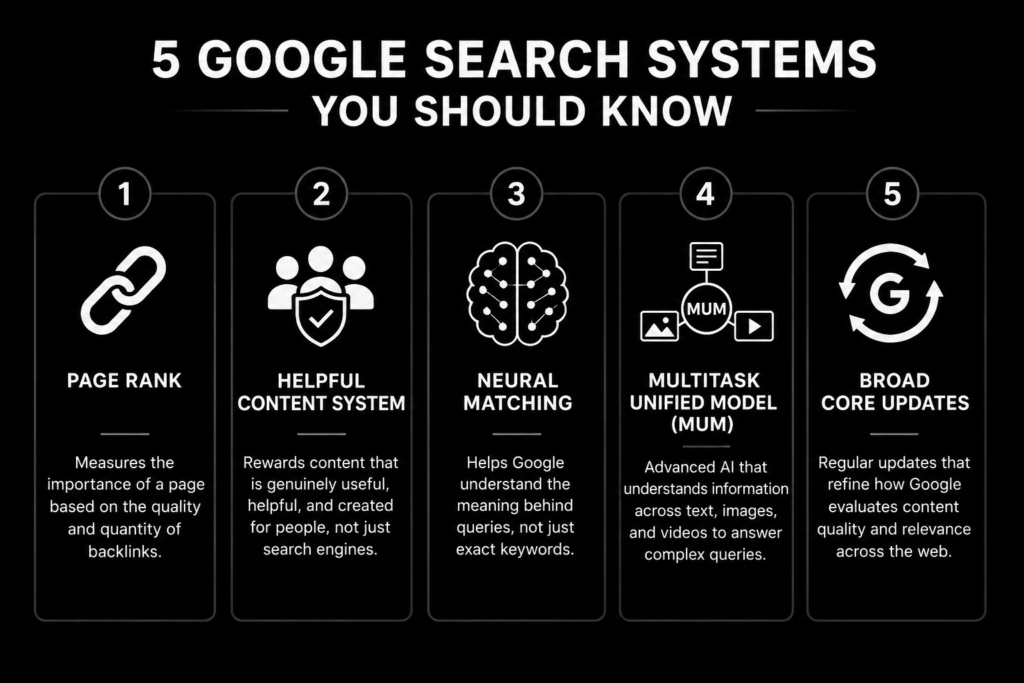
Today, Google uses advanced AI-powered search systems to understand user intent, content quality, and website experience. If you want to build a successful website or become an SEO professional, these are the five systems you should know.
1. PageRank (PR)
What is it?
PageRank is Google’s original ranking system. It measures how important a webpage is based on the quality and number of websites linking to it.
Why does it matter?
Even though Google no longer displays PageRank scores, the idea behind it still exists. Quality backlinks continue to be one of the strongest ranking signals.
My takeaway
Instead of collecting hundreds of random backlinks, I’d rather earn a few links from trusted websites. Quality always beats quantity.
2. Helpful Content System
What is it?
This system checks whether your content is genuinely helpful for readers instead of being written only to rank on Google.
Why does it matter?
If your website consistently publishes valuable content, Google is more likely to reward it with better rankings. Poor-quality content can affect the performance of the entire website.
My takeaway
Now I focus on answering people’s questions instead of simply inserting keywords everywhere.
3. Neural Matching
What is it?
Neural Matching helps Google understand the meaning behind a search query rather than looking for exact keyword matches.
Why does it matter?
Your content can rank even if it doesn’t contain the exact words someone searched for, as long as it answers their intent.
My takeaway
This taught me that writing naturally is much more effective than repeating the same keyword over and over.
4. Multitask Unified Model (MUM)
What is it?
MUM is Google’s advanced AI model that understands information from text, images, and videos to answer complex search queries.
Why does it matter?
Google now prefers comprehensive content that solves multiple related questions instead of short articles focused on a single keyword.
My takeaway
One detailed and well-structured article can be far more valuable than publishing several short posts.
5. Broad Core Updates
What is it?
Broad Core Updates are major improvements to Google’s ranking systems that happen several times each year.
Why does it matter?
These updates change how Google evaluates content quality and relevance, which can improve or reduce a website’s rankings.
My takeaway
Instead of worrying every time Google releases an update, I believe the best strategy is to keep publishing accurate, helpful, and trustworthy content.
Final Thoughts
Learning about Panda, Penguin, Humming bird, Rank Brain, Spam Brain, and BERT gave me a good foundation in SEO. However, understanding these newer search systems has changed the way I think about optimization.
At the end of the day, Google has one goal to provide users with the most relevant and helpful information. As content creators and SEO learners, our goal should be the same.
SEO isn’t about chasing algorithms anymore. It’s about creating content that people genuinely find useful. And when you focus on helping people, Google is more likely to reward your efforts.